Beyond the Stipend: 7 Surprising Truths About Google Summer of Code (GSoC) 2026
Sun Jan 04 2026
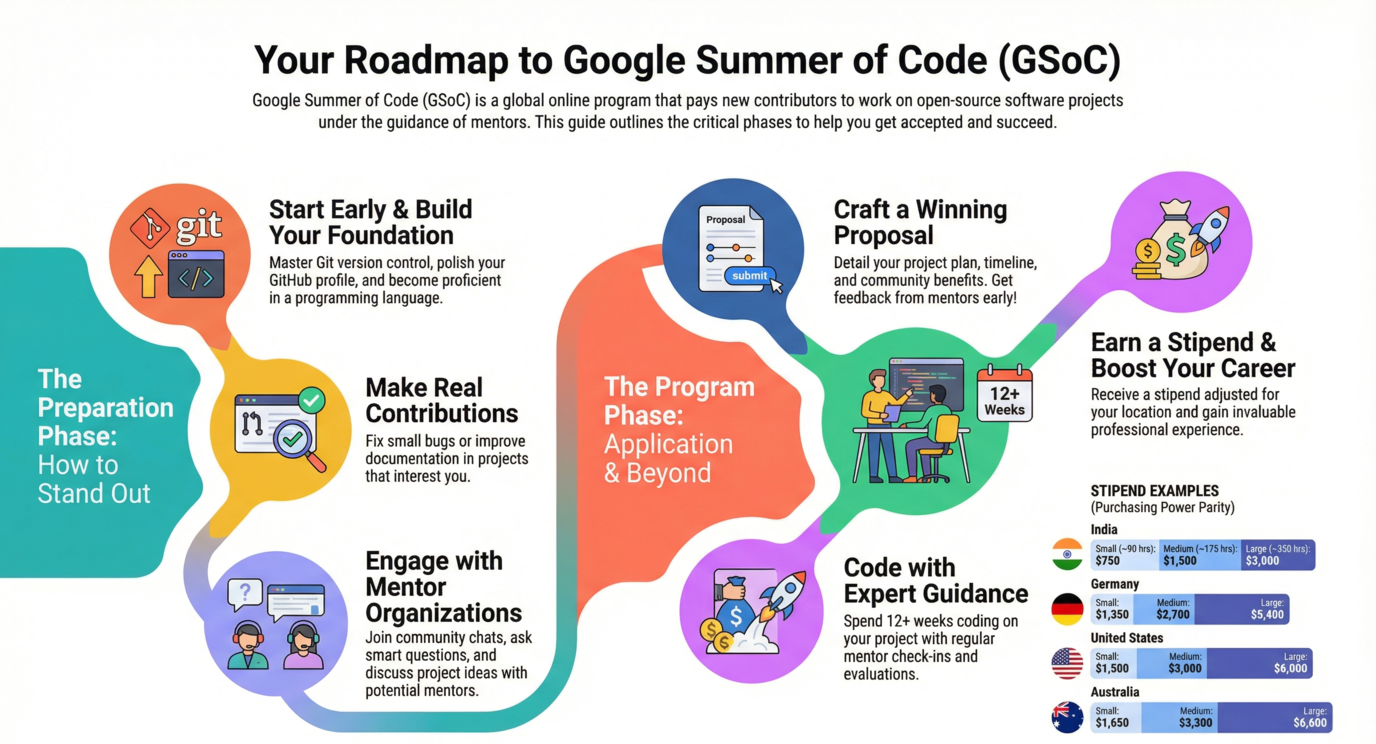
Google Summer of Code has become the gold standard for aspiring developers looking to break into open-source development. Since its launch in 2005, GSoC has welcomed over 23,000 new contributors into more than 1,000 open-source organizations, generating millions of lines of code. However, what most people believe about this prestigious program is fundamentally different from reality. If you're planning to apply for GSoC 2026, understanding these seven counter-intuitive truths could be the difference between acceptance and rejection.
Understanding What GSoC Really Is
Truth #1: It's Not a Google Internship—It's an Open Source Apprenticeship
The most widespread misconception about Google Summer of Code is that it serves as a direct pathway to employment at Google. This couldn't be further from the truth. GSoC is not a recruiting program for Google, and participants are not Google employees. Instead, you function as an independent developer receiving a stipend—not a salary.
The program's actual purpose is far more valuable for the broader tech ecosystem. Google describes GSoC as a "high-velocity conduit between aspiring developers and established mentoring organizations". Rather than serving corporate recruitment objectives, the program focuses on growing the open-source ecosystem by bringing new contributors into established communities. This positions GSoC as a structured apprenticeship in collaborative, distributed software development—teaching you the culture and practice of open source that will serve your career for decades.
Truth #2: Your Resume Matters Less Than Your Contributions
Here's where GSoC flips traditional hiring on its head. Your prestigious university degree or perfectly formatted resume won't guarantee acceptance. The program has strategically shifted from a "university-centric model" to an inclusive framework that welcomes all "open-source beginners" over 18, regardless of student status.
An "open-source beginner" is defined as someone with limited experience—working only on personal or class projects or having opened fewer than 10 pull requests. This precise definition ensures the program dedicates resources to expanding the contributor pool rather than rewarding those already established in open source.
The philosophy is powerful: The real value isn't the stipend—it's the visible, merged code in popular repositories. During technical interviews, public proof of work often matters more than the name of your college. GSoC provides verified, Google-backed work experience that levels the playing field for self-taught developers and students from non-elite institutions.
Critical Preparation Steps for GSoC Success
Truth #3: The "Real" Application Starts Months Before the Deadline
If you think GSoC success depends on writing a perfect proposal during the late March application window, you've already lost. The most critical work happens months earlier.
The golden rule for applicants is simple: Start as early as possible. The period from January to March represents the most critical phase, where serious applicants are already exploring organizations, making small contributions, and engaging with potential mentors. The program's official documentation delivers a stark warning: "Contributors who don't discuss their proposals with the target organization are very unlikely to be selected for GSoC".
Actionable Preparation Timeline:
- January-February: Research and shortlist organizations that align with your skills and interests
- February-March: Begin making small contributions—fix documentation, tackle "good first issues," and participate in mailing lists or chat channels
- March: Draft your proposal as a summary of the relationship you've already built, not as a first impression
- Late March: Submit your polished proposal with mentor feedback already incorporated
Truth #4: Your Code Might Never Be Used—And That's Okay
This truth surprises most applicants: mentoring organizations are not required to use the code produced during Google Summer of Code. The official FAQ states directly that while they hope all code finds a home, organizations aren't obligated to merge contributor code into their main branch.
Your payment is tied to performance evaluation, not code deployment. You receive your stipend based on passing midterm and final evaluations with your mentors, regardless of whether your code ships.
This reveals GSoC's deeper purpose. Unlike corporate internships where shipping features is the primary success metric, GSoC prioritizes your integration into open-source workflows. The program emphasizes the learning process—absorbing feedback, iterating on work, and becoming a competent community member. The ultimate goal is converting GSoC participants into long-term open-source contributors.
Essential Tips and Tricks for Application Success
Truth #5: Your AI Assistant Could Get You Disqualified
In an era where AI coding assistants have become standard developer tools, GSoC takes a hard line on their use. Many organizations strictly prohibit AI tools for generating project deliverables like code or documentation due to complex licensing and intellectual property concerns.
The consequences are severe. The program FAQ warns: "Using AI to write your GSoC proposal could result in an automatic rejection by the organization, depending on their individual guidance".
Critical Action Item: Verify each target organization's specific AI policy before you begin your proposal. Assume all submitted work—from proposal to final code—must be your original creation unless explicitly stated otherwise.
Truth #6: It Takes a Hidden Army to Mentor a Contributor
GSoC mentorship isn't a casual one-on-one arrangement—it's a structured, resource-intensive commitment from the entire organization. Each participating organization must assign at least two mentors per project, providing redundancy and consistent support.
Behind the scenes, Organization Administrators create private communication channels, establish time commitment guidelines, manage formal evaluation processes, and mediate conflicts. This robust institutional framework differentiates GSoC from casual volunteerism and signals its status as a mature, professional development program. In turn, this places higher expectations on contributors to engage with equivalent professionalism.
Truth #7: Success Is Underscoping Your Project
Counter-intuitively, being less ambitious in your proposal often leads to greater success. Many enthusiastic applicants propose projects far too large for the 12-week timeframe, which organizations view as red flags.
The official guidance recommends breaking large project ideas into smaller, coherent pieces and proposing completion of just the first one or two. Organizations are risk-averse—they prefer a well-scoped project certain to complete over a large project that may remain unfinished.
The principle is clear: Under-scoping is an annoyance; incomplete work is a disaster. A smaller, well-defined project demonstrates realistic planning and execution—critical professional skills that organizations value. Successfully delivering a completed, well-documented piece of work (even small) is far more valuable for your portfolio and earning organizational trust than an ambitious but unfinished project.
Practical Tips for Maximizing Your GSoC Experience
Tip 1: Build Relationships Before Submitting
Engage with your target organization's community through their communication channels. Ask thoughtful questions, help other contributors, and demonstrate genuine interest in their mission beyond just getting accepted.
Tip 2: Document Everything
Keep detailed records of your contributions, conversations with mentors, and learnings throughout the process. This documentation becomes invaluable for your proposal and future job applications.
Tip 3: Focus on Quality Over Quantity
One well-executed pull request that solves a real problem is worth more than ten superficial documentation fixes. Show depth of understanding in your contributions.
Tip 4: Understand the Organization's Tech Stack
Don't just learn the programming language—understand the frameworks, tools, testing practices, and development workflows specific to your target organization.
Tip 5: Be Professionally Persistent
Follow up on your contributions and proposal discussions, but respect mentor time constraints. Professional persistence shows dedication without being annoying.
Conclusion: Rethinking Your GSoC Strategy
Google Summer of Code represents far more than a three-month coding program or a resume booster—it's a professional immersion into open-source culture, processes, and community. The program is fundamentally designed to build developers, not just software.
The true benefits—public credibility from merged code, professional mentorship from senior engineers, and integration into a global community—far outweigh the summer stipend. These assets are precisely what the modern technical hiring market values over academic credentials alone. For self-taught developers and students from non-elite institutions, GSoC provides an unparalleled platform to prove capabilities through public, production-level code.
Now that you understand what GSoC truly represents, the question becomes: How will you shift your approach from simply writing an application to genuinely building your place in an open-source community? Your journey begins not with the application deadline, but with your first contribution today.
Ready to start your GSoC journey? Visit summerofcode.withgoogle.com and begin engaging with organizations that align with your passion and skills. Remember, the contributors who succeed are those who understand that GSoC is a marathon of community building, not a sprint of proposal writing.
🔗 Related Articles You May Like
If you enjoyed this deep dive into system design and high-level architecture, you might find these articles useful as well:
- 🔮 Coding in 2026: What Engineers Must Prepare For
A forward-looking guide on how AI, automation, and system-level thinking will reshape software development.
👉 https://www.thesgn.blog/blog/coding2026 - ⚡ VS Code vs Zed: Choosing the Right Editor for Modern Developers
A practical comparison of developer tools, performance, and workflows for today’s engineers.
👉 https://www.thesgn.blog/blog/vscode_zed - 📚 Best Computer Science Books Every Developer Should Read
A curated list of foundational CS books that strengthen problem-solving and system thinking.
👉 https://www.thesgn.blog/blog/csbook - 🏢 CRM Solutions for Business: A System Design Perspective
How scalable CRM systems are built and why architecture matters for growing businesses.
👉 https://www.thesgn.blog/blog/CRM_solutions_for_business