India's AI Revolution: What the New Delhi AI Impact Summit 2026 Means for You and the World
Sun Feb 22 2026
Artificial intelligence has been a hot topic in boardrooms, tech labs, and government corridors for years. But until now, the global conversation about AI was largely shaped by a handful of powerful Western nations. That changed in February 2026, when New Delhi stepped onto the world stage and rewrote the rules of the game. The AI Impact Summit 2026, held from February 16–20 at the iconic Bharat Mandapam, wasn't just another tech conference — it was a turning point in the history of human innovation.
Whether you're a startup founder, a farmer in rural Karnataka, a student curious about technology, or a global business leader, what happened in New Delhi directly affects your future. Here's everything you need to know.
Why New Delhi? Why Now?
Previous global AI summits were held in Bletchley Park (UK), Seoul (South Korea), and Paris (France). Each of those events focused heavily on the risks of AI — what could go wrong, how to regulate frontier models, and how to prevent catastrophic misuse. Those are important conversations, but they largely reflected the fears and priorities of wealthy, technologically advanced nations.
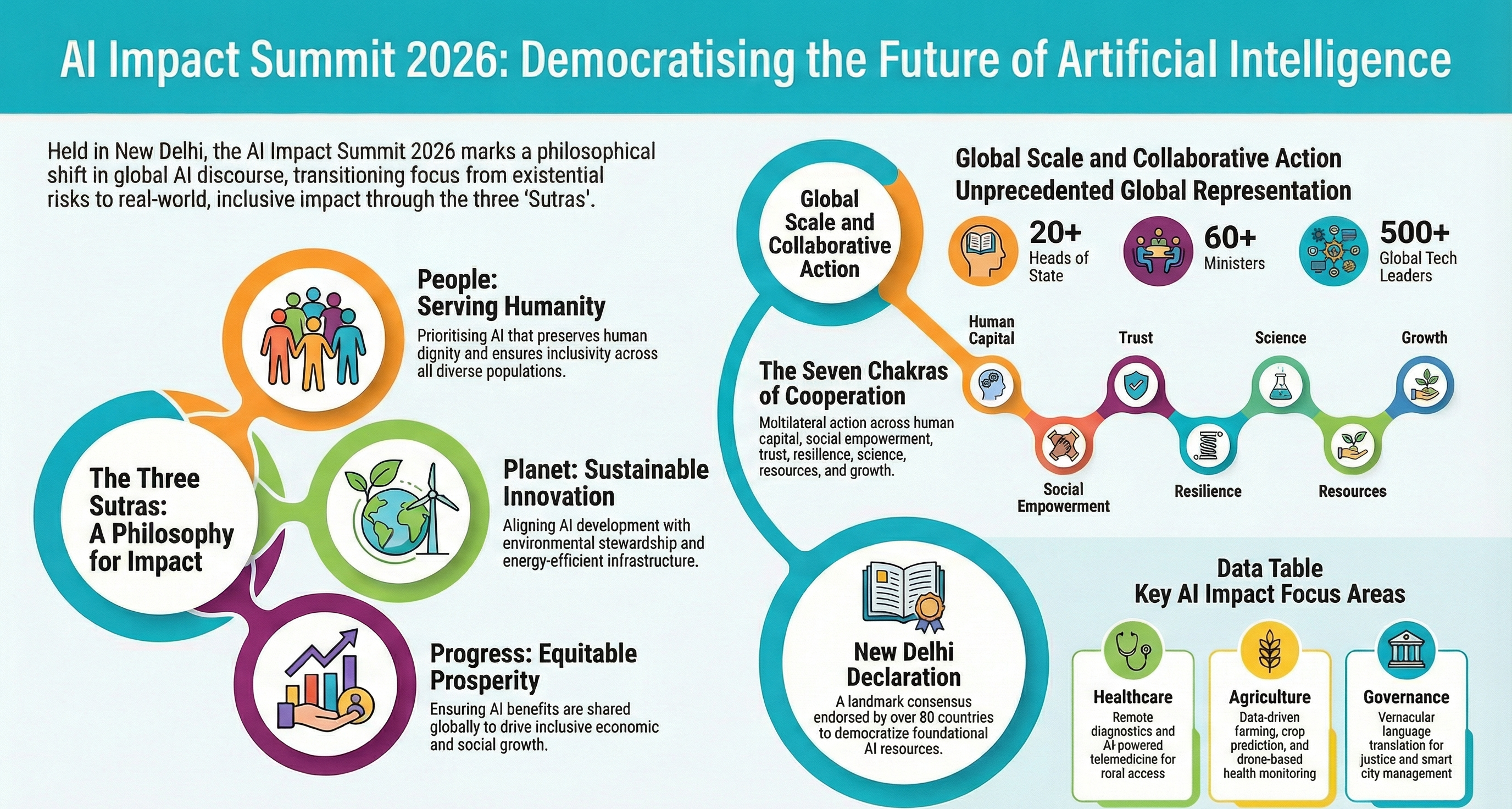
India flipped the script. Instead of asking "What could AI destroy?", New Delhi asked "What can AI build?" The summit brought together delegations from over 100 countries, including 20+ Heads of State, 60+ government ministers, and 500 global AI leaders — all united by a single, powerful idea: AI must work for everyone, not just the privileged few.
This shift from "existential risk" to "real-world impact" is not just philosophical. It's a business and policy revolution that will shape how AI is deployed, regulated, and monetized across the globe for the next decade.
The Three Sutras: A New Philosophy for AI
India introduced a values-based framework to guide global AI development, anchored by three foundational principles called the Three Sutras: People, Planet, and Progress.
People means AI must serve all of humanity — regardless of language, culture, or economic background. For businesses, this translates into a clear mandate: if your AI product doesn't work in Hindi, Tamil, Swahili, or Tagalog, it's incomplete.
Planet means AI innovation must be environmentally responsible. As AI systems consume enormous amounts of energy, this principle pushes developers toward energy-efficient architectures and sustainable compute infrastructure — a growing priority for both regulators and investors worldwide.
Progress means the benefits of AI must be shared equitably. This is perhaps the most disruptive principle for global business. It signals a move away from "winner-takes-all" technology models toward partnerships that genuinely uplift communities in developing economies.
These Three Sutras are further broken down into Seven Chakras — strategic pillars including Human Capital, Inclusion, Safe & Trusted AI, Resilience, Science, Democratizing Resources, and AI for Economic Growth. Together, they form a framework that challenges the current concentration of AI power in a few Western corporations and calls for open, interoperable, and shared AI ecosystems.
The World's Most Powerful Room
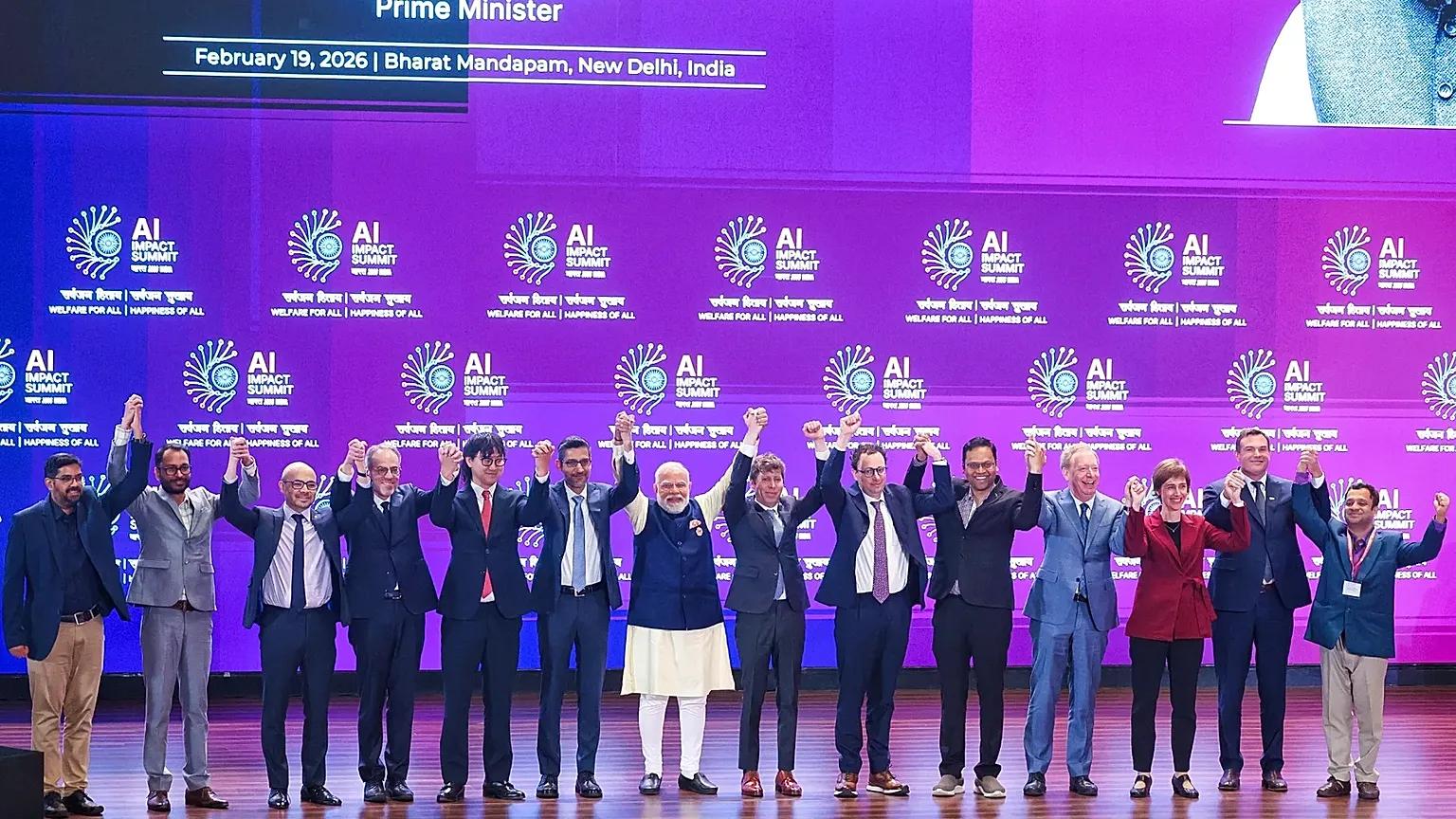
One of the summit's most talked-about moments was the CEO Roundtable hosted by Prime Minister Narendra Modi. The guest list read like a who's who of global tech: Sundar Pichai (Google/Alphabet), Sam Altman (OpenAI), Jensen Huang (Nvidia), Bill Gates (Microsoft), Demis Hassabis (Google DeepMind), Dario Amodei (Anthropic), and Arthur Mensch (Mistral AI) sat alongside Indian industry giants like Mukesh Ambani (Reliance), N. Chandrasekaran (Tata Sons), Nandan Nilekani (Infosys), and Roshni Nadar Malhotra (HCLTech).
This wasn't a photo opportunity. It was a high-stakes negotiation between the world's AI pioneers and India's infrastructure powerhouses. The message was clear: India is no longer just a consumer of AI — it is the world's most important testing ground for AI at scale. A model that works across India's 22 official languages, diverse geography, and mixed digital infrastructure can work anywhere on Earth. Silicon Valley's best products are now being stress-tested in Bengaluru, Mumbai, and rural Bihar.
India's Sovereign AI: The Tech Stack of a Nation
Perhaps the most concrete outcome of the summit was India's announcement of its own sovereign AI infrastructure — a national "strategic reserve" of intelligence that reduces dependence on foreign technology.
Key highlights include:
- BharatGen Param2: A 17-billion parameter multimodal AI model supporting all 22 Indian languages, built for governance, commerce, and citizen services
- Sarvam AI Models: Advanced 30-billion and 105-billion parameter models using cutting-edge Mixture of Experts (MoE) architecture, delivering world-class performance across regional dialects
- IndiaAI Compute Portal: A government-backed platform offering access to 34,000 GPUs at one-third of the global average cost, with plans to expand to over 58,000 GPUs total
This last point is a game-changer for Indian startups. Instead of renting expensive compute from American cloud giants, Indian developers can now build, train, and deploy AI models affordably on domestic infrastructure. This democratizes access and empowers homegrown innovators to compete on a global stage.
The New Delhi Declaration: AI for the Many
One of the summit's landmark outcomes was the New Delhi Declaration, endorsed by 89 countries and organizations — including the USA and the European Union. This voluntary framework prioritizes the developmental needs of emerging economies alongside traditional safety concerns.
The declaration introduced two landmark initiatives:
- Global AI Impact Commons: A shared platform for scaling high-impact AI use cases across regions and nations
- Trusted AI Commons: A collaborative repository of safety tools, benchmarks, and best practices for responsible AI deployment
Rooted in the Sanskrit principle "सर्वजन हिताय, सर्वजन सुखाय" — Welfare for All, Happiness of All — the declaration marks a new era in which "AI compliance" will include measuring a technology's social impact, not just its safety guardrails. For global businesses, this means the definition of a "good" AI product is expanding. Social inclusion and economic equity are becoming as important as accuracy benchmarks.
AI in the Real World: Farms, Clinics, and Classrooms
The summit released the AI Compendium — a landmark document showcasing AI's transition from lab experiment to real-world transformation across critical sectors.
In healthcare, AI-powered remote diagnostics are reaching rural areas without doctors. AI tools are already detecting tuberculosis and cancer through medical image analysis in underserved communities. In agriculture, tools like "Mossum GPT" and "Kisan E-Mitra" are giving farmers real-time weather forecasts and pest alerts in their own regional languages — directly protecting their livelihoods. In governance and education, AI is translating court judgments into local languages and personalizing learning content for millions of students through platforms like DIKSHA.
These are not pilot projects anymore. These are deployments at national scale.
What This Means for You
Whether you run a startup, manage a business, work in public service, or are simply a curious citizen, the AI Impact Summit 2026 signals one powerful truth: the age of AI exclusivity is over.
The technology that once belonged to Silicon Valley labs is now being localized, democratized, and deployed in the fields of Punjab, the clinics of Tamil Nadu, and the schools of Uttar Pradesh. India has shown the world that the most powerful version of AI isn't the most sophisticated one — it's the one that reaches the most people.
For entrepreneurs and businesses, the opportunity is enormous. Build for real problems. Build for real languages. Build for real communities. New Delhi has made it clear: the future of AI belongs to those who build for the many, not just the few.
The intelligent economy of tomorrow is being shaped today — and it looks like India.