Layoffs in 2026: The Great Realignment Behind Profits, AI, and Job Losses
Tue Feb 10 2026
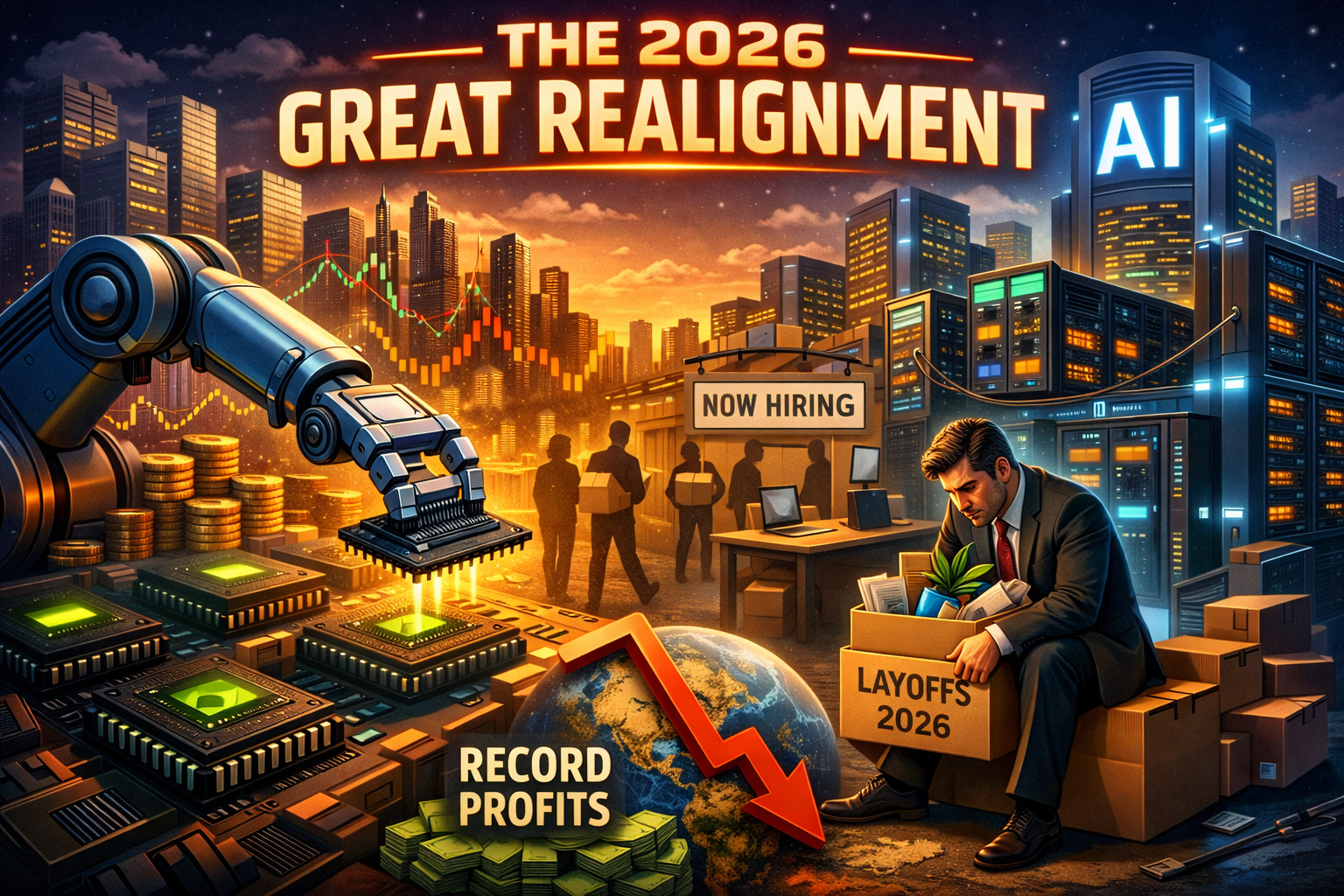
The paradox defining 2026 is stark and unsettling. While corporate America celebrates record profits and stock markets reach all-time highs, over 80,000 tech workers lost their jobs in just the first 40 days of the year. This isn't your typical economic downturn—it's a calculated transformation that industry experts are calling the "2026 Great Realignment," where companies are fundamentally rewriting the social contract with their workforce.
The Shocking Scale of Tech Layoffs 2026
January 2026 recorded 108,435 total layoff announcements across the United States—the highest January total since the 2009 financial crisis. According to Layoffs.fyi, tech and startup job cuts reached nearly 25,000 across 27 companies globally in just the first month. But unlike previous downturns, these cuts are happening while companies report robust financial health, with U.S. GDP growth at a strong 3.8% annualized rate.
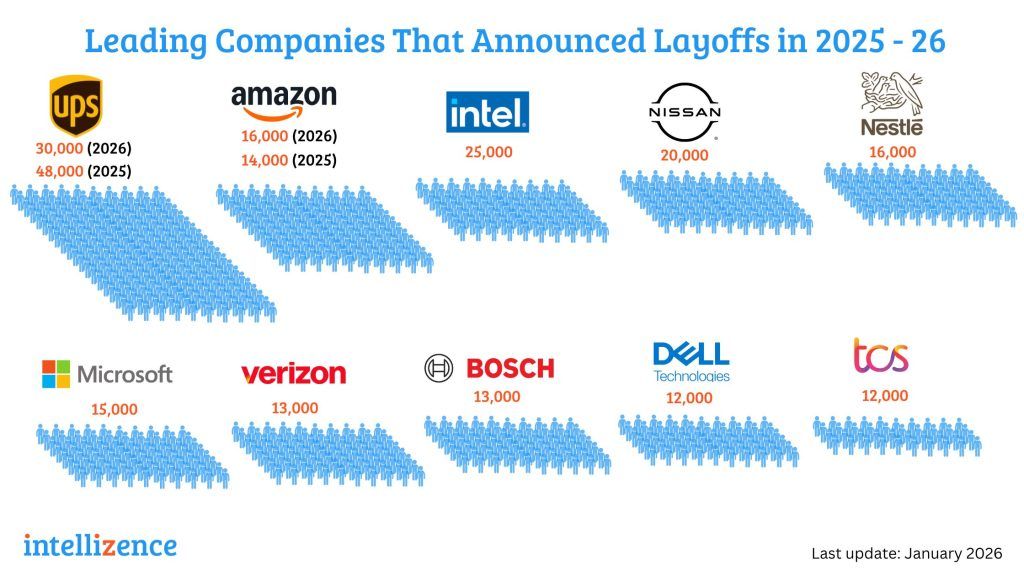
The numbers tell a disturbing story:
- Amazon layoffs 2026: 30,000 corporate roles eliminated between late 2025 and early 2026—approximately 9% of its 350,000 corporate workforce
- Oracle layoffs 2026: Plans to cut 20,000 to 30,000 positions to free up $10 billion in annual cash flow
- Salesforce: Eliminated 1,000 roles as AI agents now handle 50% of internal support tickets
- Accenture: Cut 11,000 positions, bluntly admitting reskilling wasn't viable for many displaced workers
AI Layoffs: The Real Driver Behind 2026 Job Cuts
Trading Human Capital for Computing Power
The primary engine driving mass layoffs 2026 is a massive shift in capital deployment from human labor (OPEX) to AI infrastructure (CAPEX). Companies are moving from "Software as a Service" (SaaS) to "AI as a Service" (AIaaS), viewing employees as operating expenses to be minimized rather than assets to be nurtured.
Consider Amazon's controversial $200 billion capital expenditure plan for 2026—a 50% year-over-year increase announced simultaneously with eliminating 30,000 jobs. The message is unmistakable: corporations are trading salaries for servers, choosing GPUs over people.
The AI Washing Phenomenon
While AI is genuinely transforming work, many executives are engaging in "AI washing"—using artificial intelligence as a convenient scapegoat for layoffs actually driven by traditional factors like over-hiring, profit maximization, and tariff pressures. Current data shows AI accounts for roughly 24% of cited layoff reasons, while macroeconomic pressures and investor demands for the "Rule of 40" (balancing revenue growth and profit margin) are the true pervasive drivers.
A 2025 World Economic Forum survey found that 41% of companies worldwide expect to reduce workforces over the next five years due to AI. Consulting firm Challenger, Gray & Christmas reported that AI was behind at least 55,000 job losses in the United States in 2025 alone.
Agentic AI Jobs: The 10-to-4 Displacement Ratio
The most alarming trend in AI job displacement is what researchers call "agentic displacement"—not just task automation, but the complete replacement of entire roles. Data from the Great Realignment reveals a chilling "10-to-4" ratio: for every ten roles eliminated in legacy software development, middle management, or marketing, only four new positions are created—and those four focus exclusively on AI infrastructure, governance, and ethics.
Real-world examples:
- Block Inc. leverages its "Goose" platform to automate repetitive coding and data analysis, cutting 1,100 roles to flatten management layers
- Salesforce's Agentforce platform eliminated 1,000 positions as autonomous AI now manages half the company's internal workflows
- T-Mobile used "soft layoffs" through relocation mandates, forcing employees into two-week decision windows to move or face termination
Middle Management Layoffs: The Hollowing of the Center
Perhaps the most significant casualty of the 2026 layoff trends is middle management—once the stable core of the American professional class. Amazon's "Project Dawn" exemplifies this brutal restructuring, with CEO Andy Jassy articulating a vision to operate as the "World's Largest Startup" by increasing the ratio of individual contributors to managers and removing middle-management friction entirely.
Beth Galetti, Amazon's Senior Vice President of People Experience and Technology, stated the cuts aimed at "reducing layers, increasing ownership, and removing bureaucracy". Translation: middle managers are being systematically eliminated as companies flatten organizational hierarchies.
This represents a breakdown in the social contract. When Accenture admitted that "reskilling was not a viable path" for many displaced workers after cutting 11,000 positions, they acknowledged what many fear: the corporate ladder is being dismantled, and those on the middle rungs have nowhere to go.
Corporate Layoffs Analysis: Record Profits, Disappearing Jobs
The Financial Paradox
The most perplexing aspect of mass layoffs 2026 is that they're occurring during a period of exceptional corporate profitability. Major market indices hover at all-time highs, yet companies are aggressively cutting headcount. This paradox reflects a fundamental shift in how businesses measure success—prioritizing revenue-per-employee over absolute headcount.
With the Federal Reserve maintaining interest rates in the 3.5% to 3.75% range, borrowing costs remain high. For CEOs, the choice is binary: maintain middle management or invest in AI infrastructure. Overwhelmingly, they're choosing silicon over people.
The Tariff Trap Impact
The broader labor market is caught in what analysts call the "Tariff Trap." Effective average tariff rates projected to hit 15% in Q1 2026 are crushing margins across industries:
- Stellantis: Estimated tariff bill of up to €1 billion for 2025 despite a $13 billion U.S. investment plan
- Ford: Reported $800 million in quarterly tariff costs following "Liberation Day" announcements
- Tech logistics: Hardware-dependent firms saw logistics costs spike 10-15%
This creates a ripple effect through the tech ecosystem, contributing to the "low-hire, low-fire" paradox where unemployment stays relatively low (4.4%) but hiring collapses to 17-year lows at 6.5 million openings.
Oracle Layoffs 2026: A Case Study in AI Financing Crisis
Oracle Corporation highlights the financial fragility of the AI frontier. Despite massive ambitions, Oracle navigates a "precarious financial landscape" as U.S. banks retreat from funding large-scale AI data center projects. When an Nvidia-OpenAI investment deal failed recently, Oracle's stock tumbled 2.79% as investors questioned customer funding capabilities.
To survive the financing squeeze, Oracle implemented drastic measures:
- Requiring 40% upfront deposits from new cloud infrastructure clients
- Implementing "Bring Your Own Chip" (BYOC) models to shift hardware costs
- Considering cuts of 20,000 to 30,000 roles to free up $10 billion annually for self-financing its $156 billion CAPEX commitment
Interest-rate premiums on Oracle-linked data center financing roughly doubled since September 2025, reaching levels typically reserved for non-investment grade companies.
AI Infrastructure Capex: The New Priority
The shift from human capital to AI infrastructure capex represents a fundamental reallocation of corporate resources. Companies are effectively betting that silicon is more reliable and scalable than human intellect. The physical footprint of the data center has become far more valuable than the human footprint of the corporate campus.
This "dehumanization" of the balance sheet reflects a ruthless calculation: autonomous agentic systems offer better returns than employee salaries. As companies aggressively transition toward compute power rather than headcount, traditional office hierarchies are being dismantled in favor of AI-first operations.
What This Means for Workers and the Future
The Broken Exit Market
For tech workers, the liquidity crisis compounds layoff pain. Since 2020, U.S. venture capital Net Asset Value doubled, yet the exit market remains below 2019/2020 levels. Thousands of employees at late-stage unicorns hold equity they cannot cash out because the IPO market is "broken." When laid off, they lose income while unable to access years of accumulated "paper wealth".
The Unbridgeable Skill Gap
The 2026 Great Realignment creates a skill gap that not everyone can cross. Survivors will be elite specialists who build and govern machines, while middle-management and administrative layers that once provided stable paths to the American Dream are hollowed out.
The World Economic Forum projects that by 2030, job disruption will affect 22% of all jobs, with 170 million new roles created and 92 million displaced—a net gain of 78 million positions, but with massive transitional pain.
Conclusion: Navigating the Autonomous Era
The 2026 Great Realignment represents more than unfortunate job cuts—it's the dawn of a new economic structure prioritizing revenue-per-employee models over human collaboration. While these moves lead to record profits and hyper-efficient corporate structures, they dismantle traditional paths to security for millions.
As we progress through 2026, the fundamental question remains: Is the trade-off of stability for innovation worth the cost? In the autonomous era, professional value no longer lies in managing people, but in managing the machines that increasingly manage themselves.
For the American middle class, this "Dawn" looks increasingly like an eclipse. The Great Realignment is here, and workers must adapt to a landscape where human capital competes directly with computing power—often at a significant disadvantage.