Google Summer of Code (GSoC) 2026: Complete Guide to Skills, Benefits, Application & Selection Process
Sun Jan 11 2026
Introduction
Google Summer of Code (GSoC) has transformed from an exclusive university internship into a global launchpad for aspiring developers, self-taught coders, and career-changers breaking into tech. With over 19,000 contributors trained since its inception, GSoC 2026 opens doors for beginners in open source who are 18+ years old—no college degree required. This isn't just about adding Google's name to your resume; it's about earning real-world development experience, receiving mentorship from senior engineers, and getting paid while you learn. The stipend ranges from $750 to $3,000 USD (₹60,000 to ₹2.5 lakh for Indian contributors), but the long-term career impact—direct job offers, GitHub credibility, and industry connections—makes GSoC a game-changer for engineering aspirants.
What is GSoC?
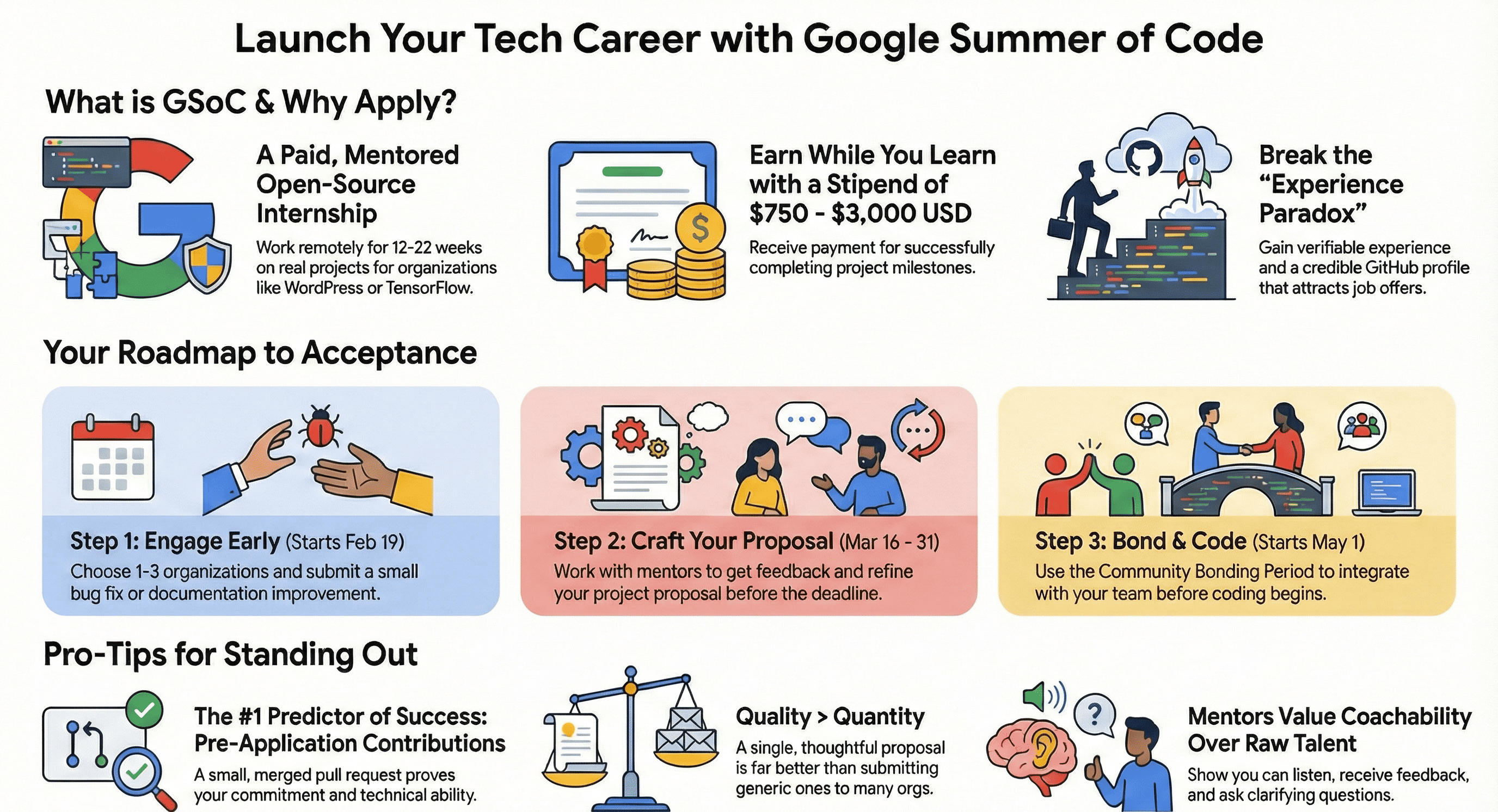
Google Summer of Code is a global initiative that pairs new open-source contributors with experienced mentors to work on real-world projects for established open-source organizations. Think of it as a paid, mentored internship where you contribute meaningful code to projects used by millions—whether it's WordPress, Debian, TensorFlow, or hundreds of other organizations. The program runs for 12–22 weeks (flexible duration based on project complexity), during which you work remotely under expert guidance, receive regular evaluations, and earn a stipend upon successful completion. Unlike traditional internships where you might spend weeks on trivial tasks, GSoC contributors solve actual problems, ship features, and see their code impact real users.
Why GSoC is Important for Students and Developers
Career Acceleration at Warp Speed
GSoC acts as a credibility multiplier in the tech industry. Several past contributors report receiving job offers directly from their GSoC organizations, while others leverage the experience to land positions at top tech companies. The program validates your technical abilities in ways a traditional resume cannot—your merged pull requests, code reviews, and shipped features serve as public proof of competence.
Breaking the Experience Paradox
Fresh graduates face the classic catch-22: jobs require experience, but how do you gain experience without a job? GSoC solves this by providing verifiable, real-world contributions that demonstrate you can navigate professional development workflows, handle code reviews, and deliver production-ready code. For students from Tier 2 and Tier 3 colleges in India who struggle to find industry placements, this becomes particularly valuable.
Mentorship That Actually Matters
Unlike passive online courses, GSoC provides 1-on-1 mentorship from senior engineers who guide you through architectural decisions, debugging sessions, and professional best practices. This relationship often extends beyond the program, creating lasting industry connections.
Purpose and Use of GSoC (Explained Clearly)
The program serves multiple strategic purposes. For participants, it's a skill accelerator—you learn production-grade development practices, collaborative workflows, and domain-specific expertise that would take years to acquire independently. For the open-source ecosystem, GSoC brings fresh talent and diverse perspectives to projects that need sustainable contributor pipelines. Google benefits by strengthening the open-source infrastructure that modern technology relies upon.
On a personal level, GSoC builds what employers actually care about: a GitHub profile filled with meaningful contributions, the ability to work asynchronously with distributed teams, and evidence that you can complete complex projects independently. The Google-issued completion certificate adds credibility, but it's the journey—the commits, the discussions, the problem-solving—that transforms your technical trajectory.
Skills Required for GSoC (With Real Examples)
Technical Foundations
You need proficiency in at least one programming language—Python, Java, C++, JavaScript, Ruby, or Rust are commonly used. This doesn't mean mastery; university-level experience is sufficient. More critical is understanding version control with Git and GitHub, since your entire workflow revolves around pull requests, code reviews, and repository management.
The Real Differentiator: Pre-Application Contributions
Here's the insider truth that separates accepted contributors from rejected ones: real effort, not resumes, is what gets you noticed. A small, merged pull request proves you can navigate an organization's specific development workflow, set up local environments, adhere to style guides, and respond thoughtfully to code reviews. Organizations like WordPress and Debian explicitly favor—sometimes even require—applicants to have submitted at least one patch or documentation fix before the application deadline.
Soft Skills That Matter
Coachability trumps raw talent. Mentors evaluate your ability to receive feedback, ask clarifying questions, and iterate on proposals based on guidance. Communication skills—documenting progress, updating mentors proactively, and participating in community discussions—are equally critical for remote collaboration.
Strategic Domain Knowledge
Projects in AI/ML (using TensorFlow, PyTorch) and cybersecurity (leveraging Go, Rust) offer competitive advantages because they address pressing real-world problems in the open-source ecosystem. If your skills align with these high-demand fields, you're positioning yourself at the industry's forefront.
Perks and Advantages of Being a GSoC Contributor
Financial Rewards
The 2026 stipend ranges from $750 to $3,000 USD based on your country of residence, paid in installments after midterm and final evaluations. For Indian contributors, this typically translates to ₹60,000 to ₹2.5 lakh—significant funding for students.
Career Capital
- GitHub Credibility: Your profile showcases contributions to well-known projects, making you stand out in job applications
- Google Certificate: Official completion certification from Google
- Industry Network: Direct connections with senior engineers and potential employers
- Higher Placement Chances: Documented evidence that boosts internship and full-time job prospects
Knowledge Ecosystem Access
You gain insider knowledge of how production systems are built, maintained, and scaled—lessons that don't exist in textbooks. The community bonding period alone provides weeks of intensive onboarding that rivals paid bootcamps.
What You Will Learn from GSoC
Professional Development Workflows
You'll master pull request etiquette, continuous integration pipelines, code review processes, and collaborative debugging—the unglamorous but essential skills that define professional software engineering.
Domain Expertise
Whether you're contributing to a machine learning library, a cybersecurity tool, or a web framework, you gain specialized knowledge in that technical domain. This positions you as a credible candidate for roles in that field.
Asynchronous Communication
Working with globally distributed teams teaches you how to write clear documentation, participate in technical discussions via mailing lists and chat platforms, and manage projects across time zones.
Project Management
You learn to break complex features into milestones, estimate realistic timelines, handle scope creep, and deliver working software under deadlines—skills that define senior engineers.
Eligibility Criteria
GSoC 2026 has remarkably inclusive eligibility requirements:
- Age: Must be 18+ years old by March 16, 2026
- Background: Open to students AND non-students (career changers, self-taught developers, industry professionals new to open source)
- Experience: No prior open-source contributions required—the program prioritizes beginners
- Commitment: Ability to dedicate 30–40 hours per week during the coding period
- Legal: Must reside in a country not embargoed by the United States and be eligible to work where you reside
- Previous Participation: You cannot have been accepted as a GSoC contributor more than once
Notably, no college degree is required, and experienced open-source veterans are often ineligible since GSoC prioritizes newcomers.
How to Apply for GSoC – Step-by-Step Guide
Phase 1: Early Engagement (February 19 – March 15)
- Explore Organizations: Browse the list of accepted mentoring organizations published on February 19, 2026
- Choose Your Focus: Select 1–3 organizations that genuinely interest you—quality over quantity
- Start Contributing: Join community channels (Slack, Discord, mailing lists), fix small bugs, improve documentation, and submit your first pull request
- Discuss Project Ideas: Engage with potential mentors about project scopes and organizational needs
Phase 2: Proposal Submission (March 16 – March 31)
- Draft Early: Submit proposal drafts to mentors for feedback—the iterative process is crucial
- Be Specific: Clearly outline project goals, implementation approach, timeline with weekly milestones, and why you're the right fit
- Show Your Homework: Reference your pre-application contributions and demonstrate understanding of the codebase
- Submit Before Deadline: Applications close March 31, 2026 at 18:00 UTC
Phase 3: Selection & Bonding (April – May)
- April 21: Organizations rank proposals
- April 30: Google announces accepted contributors
- May 1–24: Community Bonding Period—set up environment, refine milestones, integrate with the team
- May 25: Official coding period begins
Common Mistakes Students Make (And How to Avoid Them)
The "Spray and Pray" Approach
Submitting multiple generic proposals to maximize chances is a fatal error. Mentors consider this spam—it signals you haven't invested time to understand any single project. Instead, focus deeply on 1–3 organizations and craft bespoke proposals.
Treating the Proposal as a Final Exam
Many applicants perfect proposals in isolation and submit at the last minute. This is strategically wrong. Contributors who don't discuss proposals with target organizations are very unlikely to be selected. Submit drafts early and iterate based on mentor feedback.
Zero Pre-Application Contributions
Applying without making a single commit is the fastest way to get rejected. Your GSoC journey doesn't begin when you write your proposal—it begins with your first contribution.
Ignoring the Community Bonding Period
This isn't vacation time. Treating it casually sets you up for failure during the coding period when expectations escalate.
Expert Tips to Increase Your Chances of Selection
- Contribute Before You Apply: Even documentation fixes and small bug patches signal genuine commitment
- Demonstrate Coachability: Show you can incorporate feedback thoughtfully—mentors value this over raw technical skill
- Align with Strategic Domains: If possible, choose projects in AI/ML or cybersecurity where demand is highest
- Be Proactive, Not Passive: Ask questions, update progress regularly, and seek help when stuck
- Understand the Organization's Needs: Research past GSoC projects, read issue trackers, and identify genuine problems you can solve.
Conclusion
Google Summer of Code 2026 offers an unparalleled opportunity to transform your technical trajectory—earning real-world experience, building industry connections, and getting paid while you learn. Success isn't about having a perfect resume; it's about demonstrating genuine commitment through early contributions, crafting thoughtful proposals through iterative feedback, and showing you can collaborate professionally. The application window opens March 16, 2026, but your journey starts now by choosing an organization, making your first pull request, and engaging with the community. The developers who get accepted understand one fundamental truth: GSoC rewards real effort over credentials, conversations over monologues, and quality over quantity.
Key Takeaways
- GSoC 2026 is open to anyone 18+ (students and non-students), with no degree required and stipends up to $3,000 USD
- Pre-application contributions are the strongest predictor of selection—start contributing before applying
- One exceptional proposal beats three mediocre ones; focus on quality over quantity
- The Community Bonding Period (May 1–24) is critical preparation, not vacation time
- Proposals should be iterative conversations with mentors, not isolated final exams
- Projects in AI/ML (Python, TensorFlow, PyTorch) and cybersecurity (Go, Rust) offer competitive advantages
- Skills needed: programming language proficiency, Git/GitHub expertise, and strong communication abilities
- Benefits include Google certification, GitHub credibility, mentorship, and direct job placement opportunities
- Application period: March 16–31, 2026; results announced April 30, 2026
- Treat GSoC as a full-time commitment (35–40 hours/week) during the 12–22 week coding period.